How the 1937 Wheat Penny Reflects Pre-War America
The issuance of the 1937 Wheat penny coincided with the final phase of the US economic recovery following the peak of the Great Depression.
This coin serves as an indicator of the industrial activity of that time, demonstrating a significant growth in mintage compared to the early 1930s.
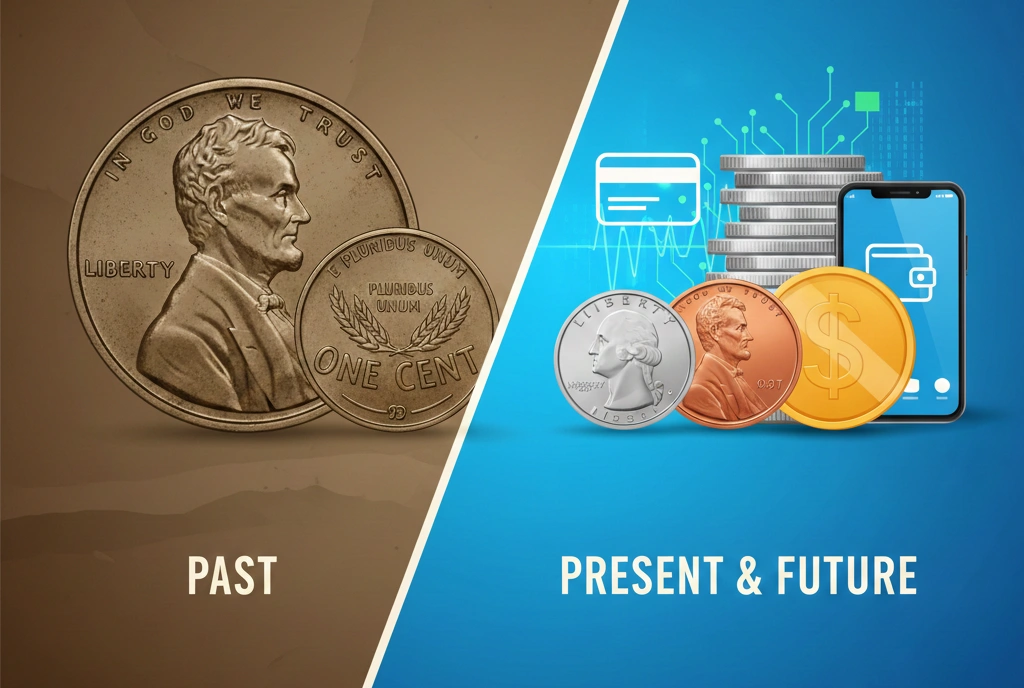
The technical execution and mintage volumes reflect the stabilization of the money supply before the country's entry into World War II.
In 1937, the US Mint adhered to traditional composition standards established for the series featuring Victor Brenner's design.
The coins were struck on bronze alloy planchets possessing high resistance to corrosion.
Composition: 95% copper, 5% tin and zinc alloy
Mass: 3.11 grams
Diameter: 19.05 millimeters
Edge Type: Plain
Production facilities in Philadelphia, Denver, and San Francisco operated in an intensified mode, providing for the increased demand of the retail sector for fractional currency.
Mintage Statistics by Mint Facility
The distribution of mintage volumes in 1937 indicates a concentration of economic activity in the eastern regions of the United States.
The total mintage exceeded the 1931–1933 figures more than tenfold, confirming the economy's exit from a state of stagnation.
Mint Facility | Mint Mark | Mintage Volume (pcs) |
Philadelphia | None | 309,170,000 |
Denver | D | 50,430,000 |
San Francisco | S | 34,505,000 |
Philadelphia (Proof) | None | 9,320 |
The significant volume of the Philadelphia issue makes the no-mark coins the most accessible on the modern market, while Denver and San Francisco issues are encountered less frequently in grades above MS66.
Impact of Pre-War Inflation on Coin Value
The purchasing power of a single cent in 1937 allowed for the acquisition of essential goods, which is impossible now.
Inflationary processes accompanying Roosevelt's "New Deal" gradually reduced the real value of the copper contained in the coin.
A 1937 cent is equivalent to approximately 22 cents in 2025 prices, demonstrating the level of currency devaluation over 88 years.
Market Value and Grading Analysis
The value of a 1937 cent is determined by its condition on the Sheldon scale with the free coin identifier app or another service, and the preservation degree of the original red color (Red - RD).
Brown (BN) or Red-Brown (RB) coins are valued significantly lower due to copper oxidation processes.
Grade | Value (USD) | Annual Increase (%) |
MS64 RD | 15.00 | +2% |
MS66 RD | 45.00 | +4% |
MS67 RD | 350.00 | +8% |
MS68 RD | 6,500.00 | +12% |
The price for specimens in MS68 RD condition demonstrates the highest dynamics driven by the supply deficit at top-level auctions.
Record Auction Sales
Trading history records exceptional sums paid for 1937 coins possessing flawless technical characteristics.
1937-D MS68 RD (PCGS): Sold in 2014 for 14,100 USD.
1937-S MS67+ RD (PCGS): Realized for 5,875 USD.
1937 Proof PR67 RD (PCGS): Reached a price of 10,350 USD.
These sales confirm that investment value is concentrated in the segment of coins having preserved their original mint luster without traces of circulation.
Varieties and Mint Errors
No mass errors similar to the 1955 "doubling" were recorded in 1937, yet local defects representing interest do exist.
Doubled Die Obverse (DDO): Slight doubling of the date and the LIBERTY inscription occurring on a limited number of dies.
Re-punched Mint Marks (RPM): Repeated punching of the "D" or "S" mark resulting from manual stamp placement on the die.
Die Cracks: Die fractures appearing as thin raised lines on the coin surface, indicating intensive equipment operation.
The value of a confirmed DDO error in MS65 condition can exceed 150–200 USD, surpassing the price of a standard coin of the same grade tenfold.
1937 Proof Category Issue
Proof coin production was resumed in 1936 after a long hiatus, making the 1937 issue the second in the modern era.
The mintage of 9,320 pieces is extremely low compared to the million-unit mintages of later decades.
Technology: Double strike by the die on a polished planchet.
Visual Markers: Mirror-like field and frosted relief (in case of Cameo effect).
Rarity: Specimens with Deep Cameo contrast are practically non-existent, being valued at sums exceeding 15,000 USD upon discovery.
Wear and Preservation in the Pre-War Period
Active coin use in 1937 led to the rapid loss of their collectible state.
Most surviving specimens have grades from G4 to VF30, possessing only nominal or minimal numismatic value (about 5–10 cents).
The survival percentage of coins in Uncirculated (MS) condition is less than 0.5% of the total mintage, explaining the sharp price jump when moving from MS66 to MS67.
The 1937 Issue in Historical Context
Four years after minting these coins, the penny's composition was changed to zinc-coated steel (in 1943) due to copper shortages for front-line needs.
The 1937 issue represents one of the last examples of "full-weight" bronze peacetime minting with high mintage figures.

Comparing the mintages of 1937 and 1942 shows a 100% production increase, reflecting the transition to a war economy and the need to provide for transactions amidst increased employment.
To distinguish a valuable coin from the mass of ordinary Wheat cents, a technical verification algorithm must be used.
Checking the Mint Mark: Using a coin checker app to look for D or S letters.
Color Determination: Comparing with RD, RB, and BN reference samples to exclude overestimation.
Searching for Micro-scratches: Inspecting the field in front of Lincoln's face for contacts with other coins.
Weighing: The mass must be 3.11 g (with an allowable deviation of 0.13 g).
The presence of original luster is a key factor determining the possibility of obtaining an MS67 grade.
Long-Term Value Forecast
Analyzing data over the last 20 years shows a steady appreciation of 1937 coins in top grades at a rate of 4–6% per year.
Inflation and the gradual reduction of market supply contribute to preserving capital invested in certified specimens.
2010 Year (MS67 RD): Average price 180 USD.
2025 Year (MS67 RD): Average price 350 USD.
Maintaining these rates might lead to the price of MS67 specimens reaching the 600–700 USD threshold by 2040.
Conclusion
The 1937 Wheat cent serves as documentary confirmation of the US economic recovery during the pre-war years.
The technical perfection of the strike and the mass nature of the issue testify to the stability of the country's industrial base at that time.
For numismatists, this year remains an important object of study, providing the opportunity to find rare grades and technological varieties.
A methodical approach to condition assessment and the consideration of historical factors allow for accurately determining the 1937 coin's place within an investment portfolio structure.